Get the Facts on the so-called “Right to Hunt” Constitutional Amendment 83.

Is Amendment 83 needed to preserve hunting and fishing in Colorado?
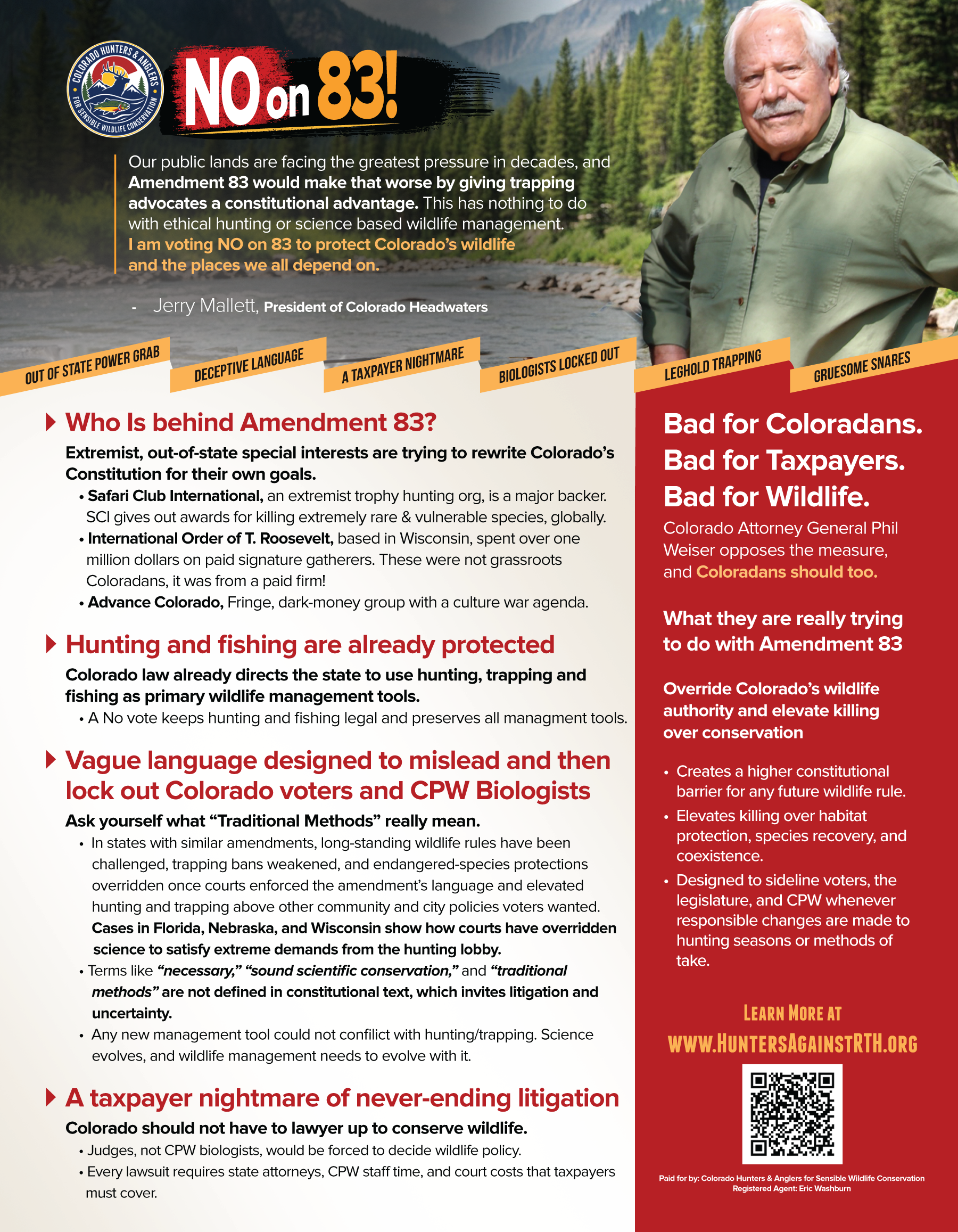
No. Hunting and fishing are already legal, protected, and central to CPW’s mission. C.R.S. § 33‑1‑101 directs the state to use hunting, trapping, and fishing as primary wildlife management tools. A strong majority of Coloradans support ethical hunting. No credible threat exists.
Does Amendment 83 simply keep current hunting laws in place?
No. Proponents openly discuss using courts to restore banned practices like bear baiting, spring hound hunting, and brutal trapping methods. The amendment’s vague language invites litigation designed to overturn existing regulations.
Does voting ‘No’ mean voting against hunting and fishing?
No. A ‘No’ vote preserves hunting and fishing in state statute and keeps all conservation tools available. It protects ethical hunting while rejecting vague constitutional language that threatens science-based management.
Is Amendment 83 necessary to protect the economic benefits of hunting and fishing?
No. Hunting and fishing licenses, outfitters, and access remain fully intact with a “No” vote. Nothing in current law threatens the economic contributions of hunting and fishing.
Is Amendment 83 necessary to help protect wildlife for future generations?
No. Future generations need clear laws, strong science and stable governance – not vague constitutional language that invites lawsuits and undermines the biologists, legislature, and Colorado voters.
Does Amendment 83 strengthen science-based wildlife management?
No. Undefined constitutional terms like “necessary,” “sound scientific conservation,” and “traditional methods” don’t protect science – they invite lawsuits. Courts, not biologists, will end up interpreting these vague terms.
Have other states adopted similar amendments without problems and unintended consequences?
No. Other states have seen litigation and policy distortion. Nebraska’s biologists were overruled on mountain lion management due to constitutional language. Florida and Wisconsin have also faced lawsuits and conflicts between courts and wildlife agencies.

“
As a fly fisherman, I support ethical hunting and fishing, which is why I oppose Amendment 83. Its vague language isn’t needed because hunting and fishing are already protected in Colorado law. Wildlife dollars should protect rivers, not fund lawsuits. We shouldn’t weaken science-based management by giving special interests constitutional power. I’m voting NO on Amendment 83.
- Charles S, Passionate fly fisherman in Colorado
Colorado Right to Hunt Constitutional Amendment
Colorado Hunters & Anglers for Sensible Wildlife Conservation Oppose the proposed “right to hunt” Amendment
Colorado Hunters & Anglers for Sensible Wildlife Conservation opposes the Right to Hunt Constitutional Amendment 84 ballot measure. Pushed by out-of-state special interests, Amendment 84 is not about protecting the ability of Colorado families to catch fish or engage in ethical hunting. Access to those activities are a key part of Colorado’s heritage and economy and are NOT in any jeopardy.
Instead, this measure is about overturning past successful efforts by Coloradans to ensure that hunting is done ethically and in keeping with the expectations and sensibilities of the majority of the public.
The amendment explicitly protects “traditional methods” of hunting, while being careful not to define what “traditional methods” means. That intentionally vague language is crafted to overturn the will of Colorado voters who banned some cruel practices decades ago.
Under this measure, archaic practices like steel-jawed leghold traps, wildlife killing contests, hunting bears through baiting, with hounds, or in the spring when cubs are vulnerable to the loss of their mother could all come back into practice.
If this amendment passes this November, there will be a rush to the courthouse by proponents of these “traditional methods” to claim that the Right to Hunt ballot measure, now part of the Colorado Constitution, prohibits these existing voter-approved bans on “traditional methods,” and that they must be struck down.
We cannot risk letting out-of-state interests take our treasured traditions and the conservation efforts that ensure them backwards in this way.